Having opened in 2007, the Sheikh Zayed Grand Mosque may be a relatively new piece of architecture, but it’s certainly made its way quickly up the list of places to visit for architecture lovers and travel lovers alike. Blending inspiration and materials from a number of countries and cultures, the Mosque stands as a a landmark of modern Islamic architecture and is absolutely is one of the most beautiful buildings I’ve seen.

As soon as you arrive at Sheikh Zayed Grand Mosque, you can tell it has a special aura to it. Firstly the grandness of it (the giveaway is in the name!) is hard to put into words – it is one of the largest mosques in the world, with the ability to accommodate over 50,000 worshippers at one time!
It was the founder of the United Arab Emirates, the late Sheikh Zayed bin Sultan Al Nahyan, who had the vision of a mosque that wasn’t just a place of worship. It was built to be a cultural hub that bridges the past with modern design and craftsmanship.
Here’s all the things that make it so special.

Key design elements were shipped from all over the world
One of the most special things about the Sheikh Zayed Grand Mosque is that its design and construction incorporate materials and artisans from around the globe. From Italy, Germany, Morocco and India, to Turkey, Iran, China, and Greece, materials have been sourced from all over.

Sheikh Zayed Grand Mosque has the world’s largest chandelier
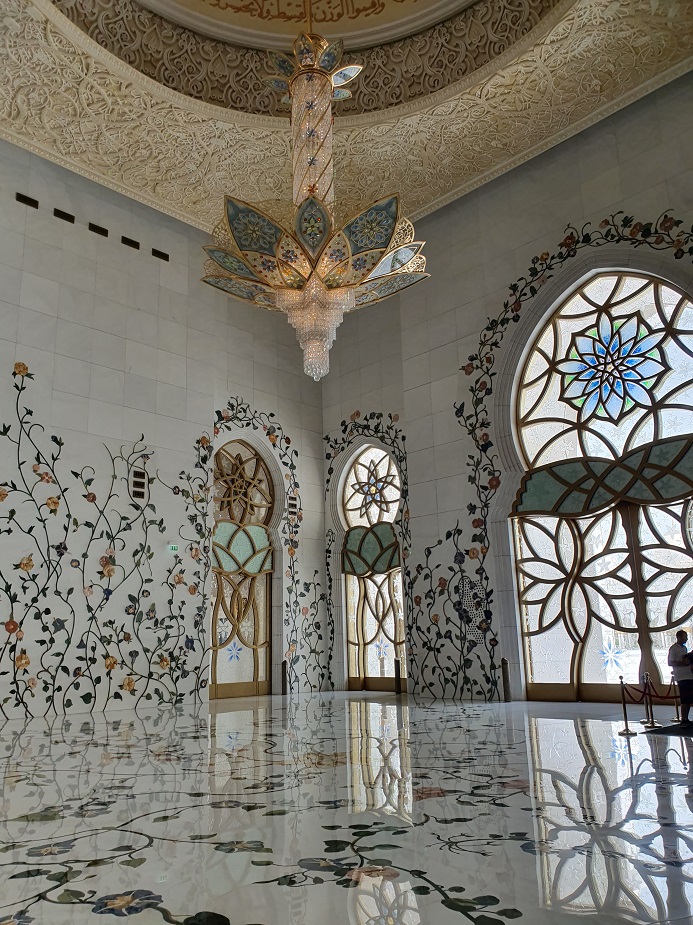
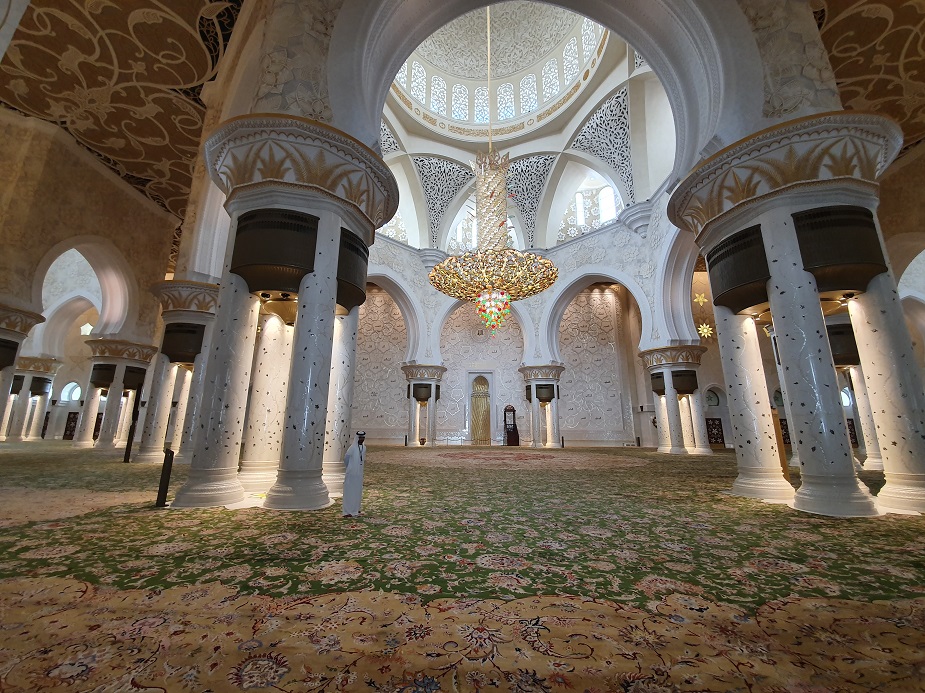
The largest chandelier, situated in the main prayer hall, measures approximately 15 metres in height and 10 metres in diameter. It has the world record for the world’s largest chandelier! The interior of the mosque is adorned with 7 imported chandeliers in total, imported from Germany and that rank among the world’s most extravagant. These chandeliers incorporate millions of Swarovski crystals, which create a breathtaking lighting effect within the prayer halls.
Sheikh Zayed Grand Mosque has the world’s largest carpet
The Sheikh Zayed Grand Mosque holds distinction for its massive hand-knotted carpet, which covers the floor of the main prayer hall. This carpet, weighing 35 tonnes and measuring 5,627 square metres, holds the record as the world’s largest carpet. Over 1,200 artisans worked together to craft the carpet, completing the masterpiece in two years.
The mosque looks blue at night
During the night, with the help of 22 light towers, the mosque transforms with a unique 360-degree lighting system designed to sync with the lunar cycle. The building changes from a bright, cool white during a full moon to a deep, dark blue as the moon wanes.
You actually enter underground
You may expect to just walk right up to the mosque, but you actually enter via the Souq Al Jami’, a modern underground shopping mall. This is where you can find coffee (The Coffee Club), buy a last-minute headscarf, and use the toilet before heading to the main structure.
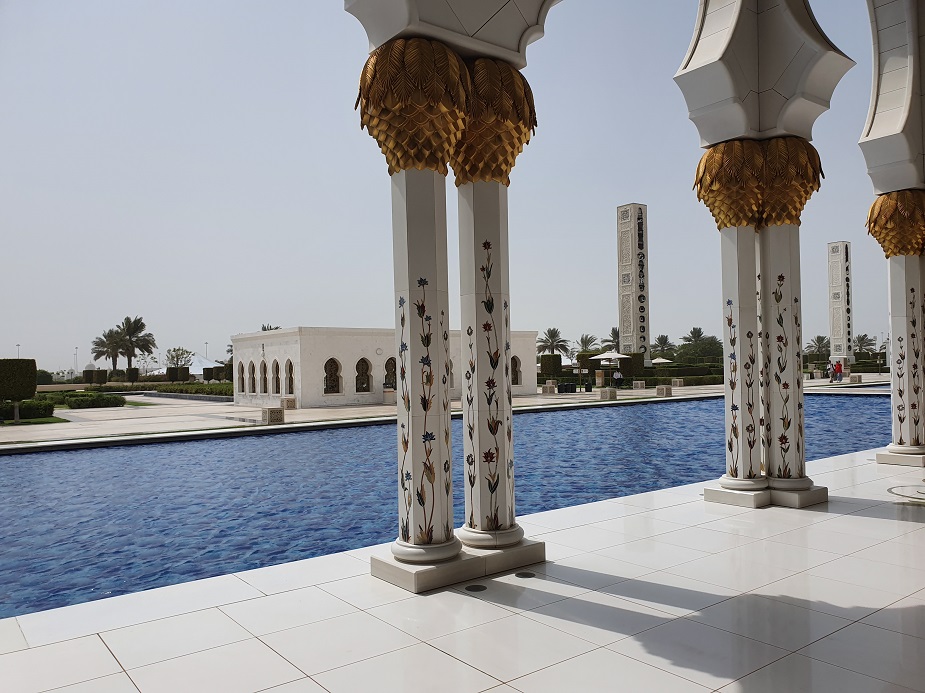
The mosque is surrounded by reflective pools
Extending over 7874 m2, rectangular pools tiled in different shades of blue surround the mosque. For me I love being near water (even if you can’t go in it here!), especially when it’s a hot place like Abu Dhabi. It brings me a sense of calm. However the pools are said to be more spectacular at night, when the lights are on and the beautiful detailing of the pillars are reflected in the water.
It cost £545 million to build
The construction of the Sheikh Zayed Grand Mosque stands as a testament to lavish architectural ambition. The total cost for this iconic building reached an estimated 2.5 billion AED (approximately £545 million).
The cost included not only construction materials but also the intricate craftsmanship involved:
- Marble: Imported from Italy and Macedonia
- Gold: 24-carat gold gilding
- Crystal: Chandeliers made with Swarovski crystals from Austria
- Carpets: Custom hand-knotted from Iran

Sheikh Zayed Grand Mosque has the world’s largest marble mosaic
The floral “Sahan” (courtyard) is 17,400 square metres and features the world’s largest marble mosaic. As you’ve probably guessed by now, they really went big with this mosque to hold several world records! The flowers depicted (tulips, lilies, and irises) were chosen because they grow in the Arabian Peninsula.
The courtyard is made of a specific type of Macedonian Sivec marble. This marble is famous for its thermal properties so it stays cool to the touch even when the Arabian sun is at its peak.
The four minarets are an unknown history lesson
Each 107-metre minaret (the four towers at the corners of the mosque) is divided into three different sections, each representing a different era of Islamic architecture:
- Square Base: Moroccan/Andalusian style
- Octagonal Middle: Mamluk style (from Egypt)
- Cylindrical Top: Ottoman style (from Turkey).
This was done intentionally to “bridge” different centuries of Islamic history into one modern masterpiece.
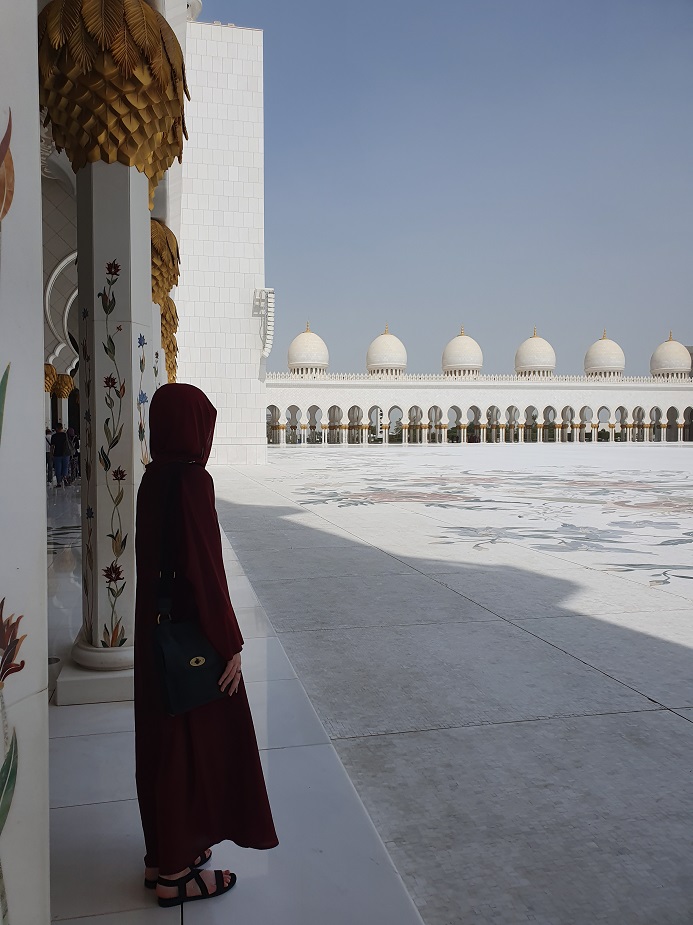
The tops of the pillars are shaped like upturned palm trees
As you can see above me in the photo, the tops of “the golden capitals” are like upturned palm trees. The palm tree is the ultimate symbol of life and sustenance in the United Arab Emirates, with the architects paying homage to the desert heritage of the nation.
We took a day trip here from Dubai and it’s honestly one of the most astounding places I’ve visited. I’d really recommend visiting if you can. Find out more about this beautiful place here.
Sheikh Zayed Grand Mosque FAQs (2026)
The mosque is situated in Abu Dhabi, the capital of the United Arab Emirates. Those driving from Dubai can reach the mosque via Sheikh Rashid Bin Saeed Street. If you’re staying in Abu Dhabi, buses run regularly to the mosque.
It takes about an hour or so to drive each way. Dubai drivers are a law unto themselves, so be wary that it can be more stressful than driving in the UK! There is plenty of parking available on-site which is free. You can also book a taxi to go from Dubai to the mosque if you’d prefer.
Entry is completely free, but you must register for a ticket. You can do this online in advance to skip the queues at the Visitor Centre.
Both men and women must cover their arms and legs. Women are also required to wear a headscarf. As of 2026, the mosque no longer provides free abayas/clothing for rent, so you must come prepared or purchase one at the underground Souq Al Jami’.
Yes, the mosque has an “Open Doors, Open Minds” policy and welcomes visitors of all faiths. Respectful rules to abide by include no food or drink, no smoking, and no overt displays of affection. Be mindful there are guards around the mosque keeping watch.
Typically the mosque is open Saturday to Thursday, 9am-10pm. On Fridays, it is closed for tourists in the morning and reopens at 3pm (or 4.30pm depending on the season).
Yes you can absolutely take photos and videos but you must stay within the “Photo Stops”. If you try to pose for a shot in the middle of a walkway, a guard will politely ask you to move.
You can wear shoes in the outdoor courtyards and walkways. You must remove your shoes before stepping onto the hand-knotted carpet in the Main Prayer Hall.

Sophie is a freelance writer and editor, and the founder of Britain and Beyond.
