The Crystal Grotto at Painshill is a unique and enchanting underground cave that really took me by surprise when I visited. There’s plenty to see and do at Painshill, but for me the Crystal Grotto was the stand-out attraction as it’s so unusual. It’s a man-made cave that is constructed from a variety of natural materials, including rock crystals, shells, and minerals.

The grotto was commissioned by Hon. Charles Hamilton, an 18th century landscape designer who created the whole of Painshill Park. Inspired by his travels and the grottoes he visited in Italian Renaissance gardens, he commissioned a celebrated grotto maker, Joseph Lane, to construct it in 1760. It cost around £8,000, which would be equivalent to over half a million pounds today.

From the outside, it is very inconspicuous. As you can see from the above photo, it simply looks like cratered rock. Even when you approach the entrance to it, it looks like it’s just going to be a short pathway through a cave.
But when you get into the Painhill Park Crystal Grotto, you’ll be astounded by how beautiful it is. As you walk in you’ll feel a sense of coolness in the air and crystals and minerals will surround you on the walls.
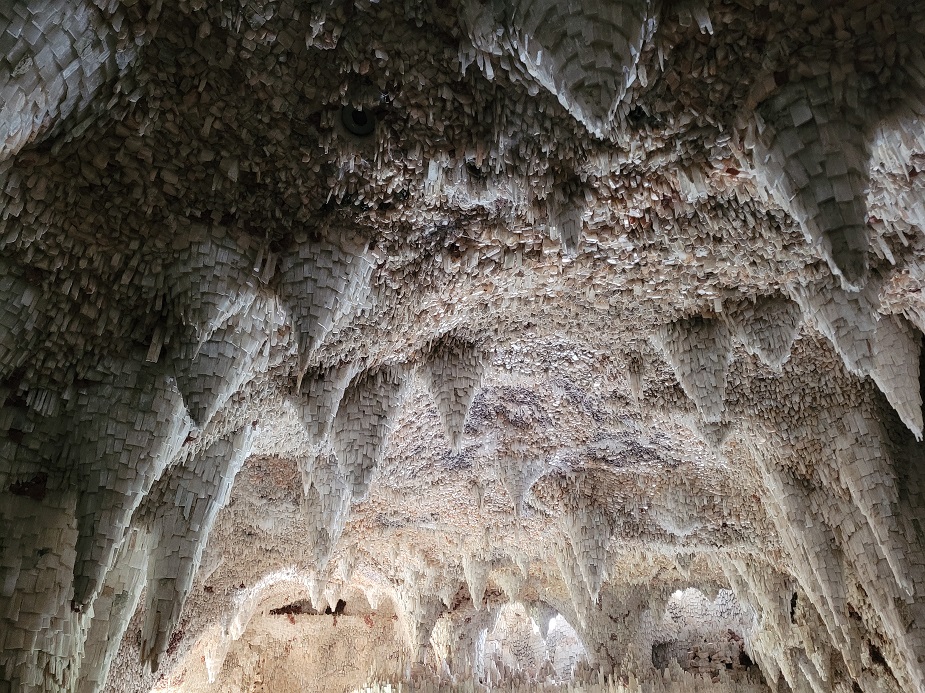
It’s not until you get into the main chamber that you can appreciate not only the extent of the work put into creating the grotto, but also how much must go into maintaining it. The ceiling is awash with crystals like quartz and calcite, as well as stalacites – a mineral formation that hangs from the ceiling of caves. There are over 10,000 crystals in the grotto altogether.

The natural daylight that filters in and bounces off of the lake creates a magical, sparkling ambiance, and there’s a small bubbling brook that adds to the tranquillity. As you can imagine, visitors back in the 18th century were filled with wonder at its beauty and German landscape designer Friedrich Ludwig von Sckell (1750 – 1823) called it “the finest of its type ever built”.

Sadly, like so much of Painshill, it fell into disrepair after World War II and by the late 1940’s the roof of the grotto had collapsed. Thankfully due to funds given to the Painshill Park Trust by the National Lottery Heritage Fund, the grotto was able to be restored to its former beauty and can be enjoyed for many more years to come.

Visiting the Painshill Park Crystal Grotto was a unique experience for me, as I have visited many landscaped gardens over the years but never seen anything quite like this grotto. It’s a must-see on a visit to Painshill, however it’s worth noting that the grotto closes every Monday for maintenance so avoid this day if it’s something you want to see.
There’s plenty more to see at Painshill too, including follies, temples, and bridges – which you may recognise from episodes of Netflix’s Bridgerton. It is a great spot for a day out and I’d highly recommend adding it to your visit list!
Painshill Crystal Grotto FAQs (2026)
No, unlike the rest of Painshill Park, the Grotto has specific opening hours. It’s also closed on Mondays for maintenance and may be closed on certain other days during the year for events. It’s always best to check on the official Painshill website before you set off.
Nope! Entrance to the Crystal Grotto is included in your general Painshill admission ticket. Once you’re in the park, you’re free to marvel at the crystals as much as you like.
There are over 10,000 crystals in this manmade cave altogether. It is a really incredible sight to see.
The path to the Grotto is accessible, but the interior can be a bit tight. The Grotto is generally accessible for standard wheelchairs, though the surface is slightly uneven. For those with larger “all-terrain” strollers, you might find it easier to park them just outside the entrance.
From the visitor centre at the entrance, it’s about a 20 to 30-minute walk. Painshill is a “long walk” park (the full circuit is about 2.5 miles), so wear comfortable shoes!
While Painshill is very dog-friendly (as long as they are on a short lead), dogs are generally not allowed inside the Grotto itself to protect the delicate crystal structures.

Sophie is a freelance writer and editor, and the founder of Britain and Beyond.
