If someone asked you to name the first thing that comes to your mind when you think of Las Vegas, you’d probably say the Las Vegas Strip. After all this is where most of the hotels and casinos are, and it’s what you see in all the modern movies. But the Strip is not where Vegas started – Fremont Street is the real OG! Fremont was the centre of everything, and it holds some incredible history.
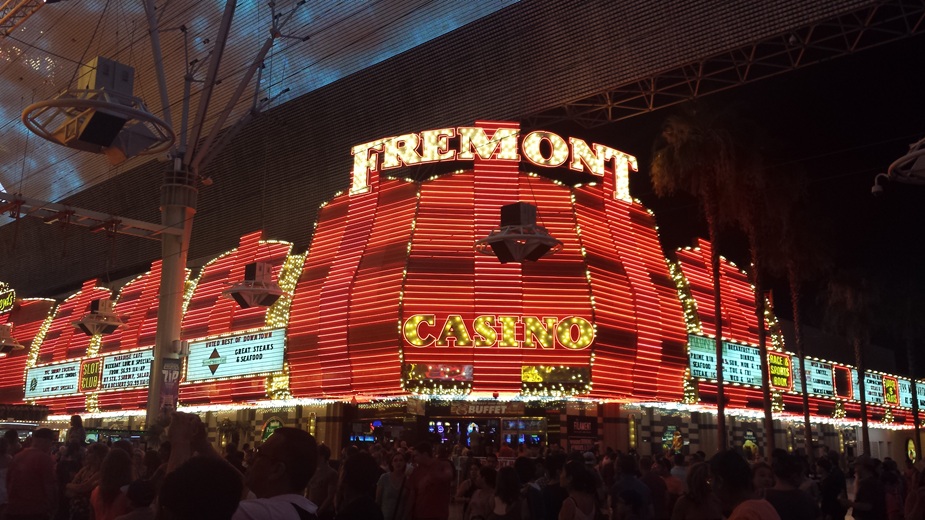
Fremont Street was home to a number of firsts
The Golden Gate Hotel & Casino opened in 1906 (as Hotel Nevada) and is still operating today, over 120 years later. This is also where the city’s first phone was installed in 1907; its number was simply “1.”
While the rest of Vegas was still a dusty desert, Fremont Street now had several hotels, and was the first place to get pavement in 1925.
The Northern Club on Fremont Street received the very first legal gambling license issued in Nevada in 1931. This was the same year that the city got its first traffic light – which is crazy when you see how many traffic lights are in Las Vegas now!
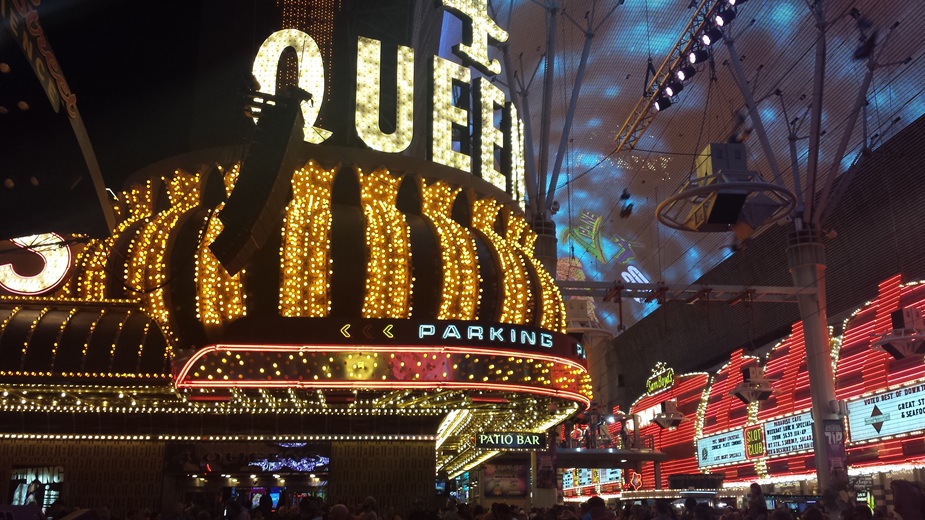
The “Glitter Gulch” era defined Las Vegas
From the 1940s to the 1960s, Fremont Street earned the nickname “Glitter Gulch.” This was the era when the casinos like the Pioneer Club and Binion’s competed to have the brightest, most elaborate neon signs to draw in new customers. This effectively created the “in your face” look of Las Vegas that the world still recognises today.
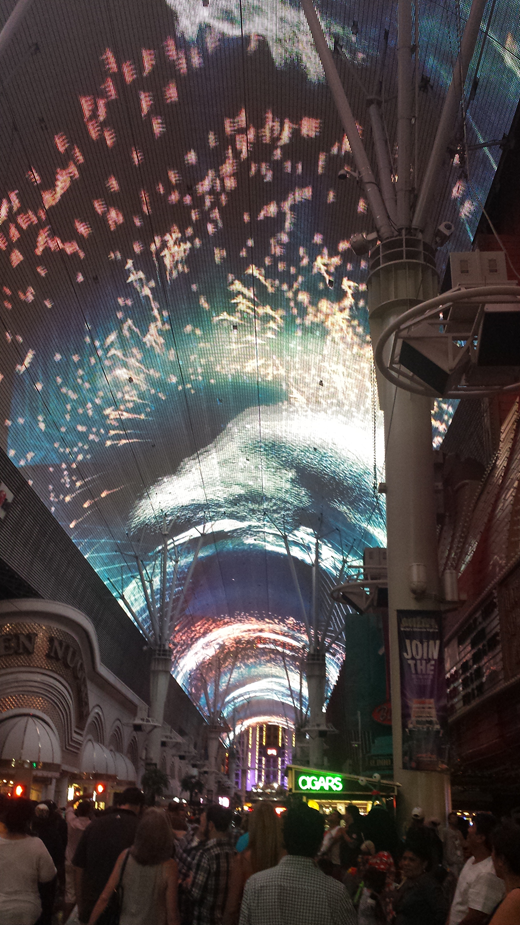
The “Fremont Street Experience” opened in the 90s
In the 1980s and 1990s, the massive mega-resorts on the Strip (like the Mirage) started taking over Las Vegas. Fremont Street was almost killed off with less people visiting, so to compete with the Strip, something new and different needed to be done.
Downtown leaders decided to do something radical: close the street to cars forever, and build a giant LED canopy over the street, calling it the “Fremont Street Experience“. Nothing like this had been done before, with a cost of $70 million.
The canopy has been recently revamped and is the largest single digital display in the world, featuring over 49 million LED lights and a 600,000-watt sound system. A free light show synced to music, plays across the canopy every night on the hour, starting at 6pm.
Also installed was a massive 12-story slot-machine-themed tower where you can fly over the crowds. You can choose the lower “Zipline” (77ft high, seated position) or the “Zoomline” (114ft high, superhero-style) which travels the full five blocks under the canopy.
This historical move saved the district and made it unique, with half of Las Vegas’ annual tourists still visiting Fremont Street to this day.
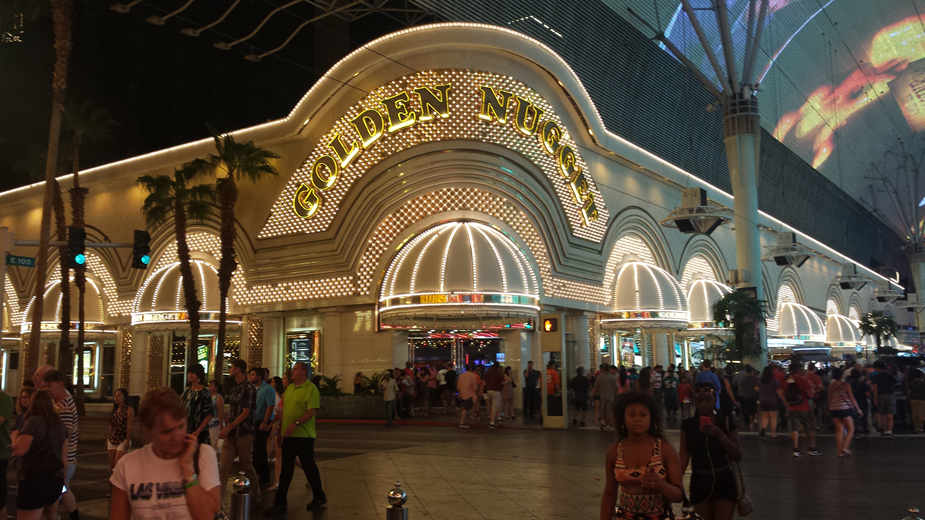
There’s plenty of random artefacts
Fremont Street has a lot of random artefacts dotted around. For example, the Golden Nugget houses the world’s largest gold nugget currently in existence. Found in Australia in 1980, it weighs a staggering 61 pounds (27.2 kg). Meanwhile, inside the men’s restroom at Main Street Station, there is a genuine, large slab of the Berlin Wall behind the urinals, which is one of the weirder things I’ve learnt! At Binion’s, you can take a free photo standing behind $1 million in cash (arranged in a pyramid of $100 bills) – one of the few things in Vegas that has remained free for decades.
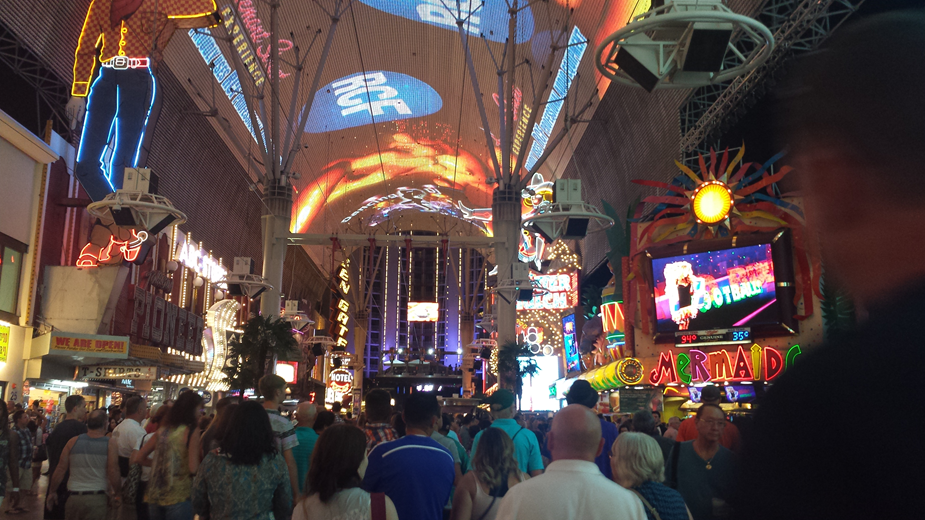
Newer additions to Fremont Street to look out for include the 25-foot-tall neon cowgirl ” Vegas Vickie” which was originally on Fremont Street in 1980 and has been restored and added to the lobby of the Circa Resort in 2020.
Another addition is a new mural that was unveiled in late 2025 which pays tribute to the “grit and glamour” of Downtown. It’s a great wall to get a photo in front of, and it’s located behind the 3rd Street stage.
If you take a trip to Las Vegas, you can’t miss Fremont Street – it is the birthplace of the city and has a completely different but brilliant energy compared to the Strip.
Fremont Street FAQs (2026)
The Strip is located in Clark County and is home to massive “mega-resorts,” whereas Fremont Street is the historic Downtown district. Fremont is more compact, pedestrian-only, and generally cheaper for gambling and drinks. While the Strip is about luxury and scale, Fremont is more about vintage vibes with the modern canopy twist.
The shows typically run every hour on the hour, starting at 6:00pm and ending at 2:00am. Each show lasts about 6–7 minutes and features high-resolution LED graphics across the street’s canopy, synced to popular music. It is amazing to watch!
Yes! It’s completely free.
Within the Fremont Street Experience, it is very safe due to a heavy presence of private security and police. However, visitors should be cautious when walking more than two blocks East or West of the main canopy area after dark, as the surroundings can become industrial or residential very quickly.
It was named after John C. Frémont, an American Army officer, explorer and politician who travelled through the Las Vegas Valley in 1844. His reports were some of the first to describe the area’s natural springs, which were essential for travellers heading to California. When the city was officially founded, the street was named in his honour to recognise his role in putting the region on the map.

Sophie is a freelance writer and editor, and the founder of Britain and Beyond.
